home / guides/is-my-remodel-bid-too-low-spotting-contractor-red-flags
Remodeling Advice · October 23, 2026 · 8 min read
Is my remodel bid too low? Spotting contractor red flags
Learn how to spot red flags in low remodel bids. Compare promised costs and timelines against actual Los Angeles averages before you hire a contractor.

Getting your first few contractor proposals can be an eye-opening experience for any homeowner. You might receive three estimates for the exact same remodeling project, only to find that one comes in drastically lower than the others. While your first instinct might be to celebrate finding a fantastic deal, a bid that falls far below local averages is often a major warning sign. It usually indicates that the contractor is either inexperienced with local costs or intentionally hiding the true expenses to win your business.
Understanding exactly what goes into a realistic estimate is the only reliable way to protect yourself from costly surprises later in the process. Many homeowners find out too late that a cheap initial proposal simply meant important details were left out entirely. As an independent matching service, LA Premier Builders helps you compare contractors and their proposals side by side, with absolutely no pressure.
We match homeowners with contractors, allowing you to evaluate your options objectively. We provide the introductions, and you decide how to proceed. Learning to spot the red flags in an unrealistic bid will save you from endless frustration and budget overruns as you plan your project.
The anatomy of an incomplete estimate
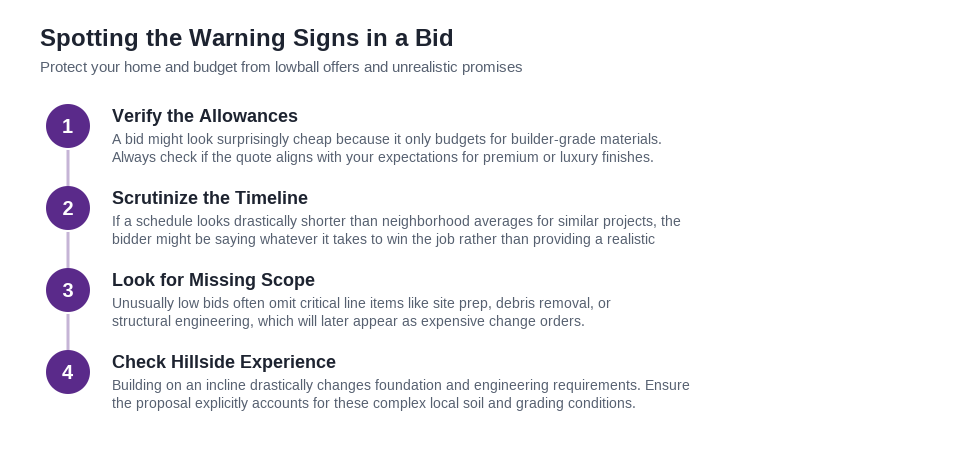
When a remodeling proposal looks too good to be true, it almost always is. Contractors who submit unusually low numbers often do so by omitting necessary phases of work or making overly optimistic assumptions about the existing structure of your house. They might leave out the cost of interior demolition, hazardous material testing, site preparation, or daily waste disposal. These are not optional steps, and the costs will inevitably show up on your final bill as unexpected change orders once the work has already started.
Another common tactic is providing allowances for finish materials that are completely out of touch with your actual tastes and the neighborhood standards. If the estimate includes a tiny budget for flooring or cabinetry, you will end up paying the difference out of pocket when you select the hardwood or custom doors you actually want. This approach makes the initial number look appealing while effectively hiding the true financial commitment required to finish the space to your expectations.
You also have to carefully consider the business side of the contracting industry. A company offering rock-bottom pricing might be struggling to find steady work, cutting corners on necessary liability insurance policies, or planning to use cheaper, less experienced labor for complex tasks. They might also be planning to manage multiple jobs simultaneously, meaning your home will sit empty for days at a time. None of these scenarios end well for your property or your overall budget in the long run.
Benchmarking against actual local costs
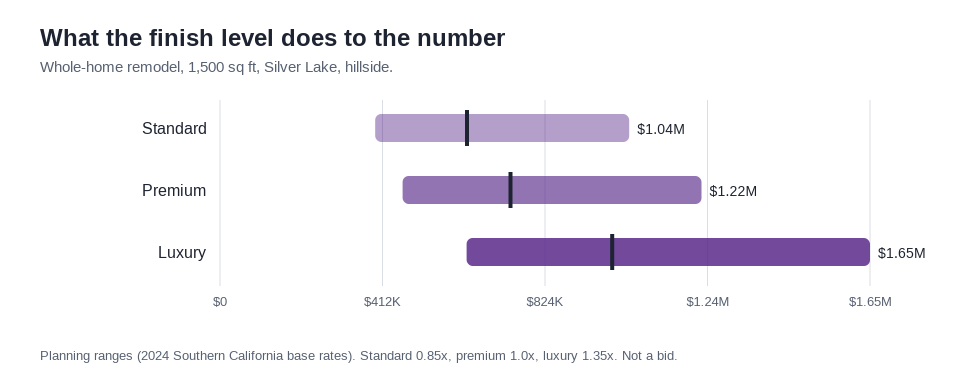
To successfully spot a problematic estimate, you need a realistic baseline for what remodeling actually costs in your specific area. Having real data prevents you from falling for a lowball offer. For example, consider a 1,500 sq ft whole-home remodel in Silver Lake. If you are aiming for a standard finish level with basic but durable materials, the mid-point planning range for this type of project is roughly $626K.
If a contractor hands you a proposal for that exact same project that totals far less than the low end of $394K, you need to ask some very serious questions. They are likely missing massive portions of the necessary scope, or they are significantly underestimating the labor required. Moving up to a premium finish pushes that mid-point expectation to $737K. An unusually low bid on a high-end architectural project is a sure sign that the contractor simply does not understand the level of detail you expect.
Having accurate, localized numbers helps you push back effectively during the interview process. When you know the typical ranges for your neighborhood, you can ask the contractor exactly how they plan to achieve such an unusually low price. Their answer will usually reveal whether they have a genuine efficiency advantage, such as strong supplier relationships, or if they are simply leaving crucial things out just to win the job.
Spotting impossible timeline promises
Cost is certainly not the only area where unrealistic promises cause major trouble for homeowners. Many people are eager to get their project finished quickly, and some contractors will exploit this natural impatience by promising impossible schedules. In reality, the timeline is often heavily dictated by municipal processes and supply chain realities that no single person can speed up, regardless of what they promise during a sales pitch.
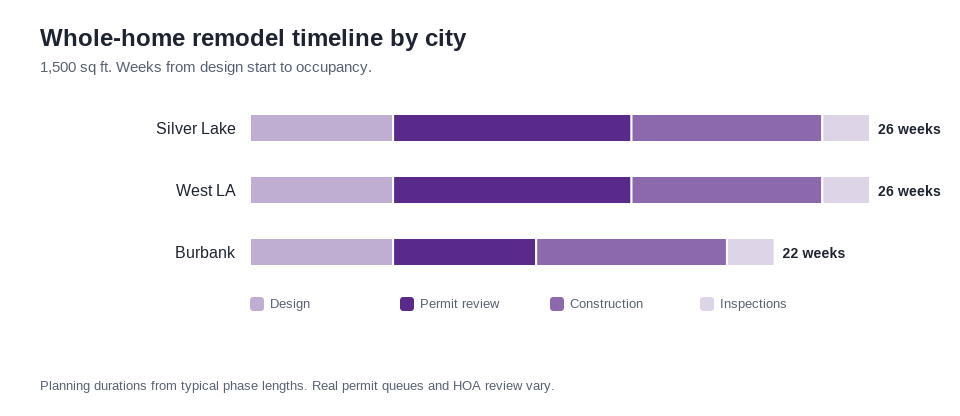
Looking at a typical project in Silver Lake or West LA, the total duration from design start to occupancy is typically 26 weeks. A massive chunk of that time is spent waiting on the city to review plans and issue approvals. Specifically, the permit review phase alone takes about 10 weeks. If a contractor tells you they can finish the entire job from start to finish in a much shorter timeframe, they are either planning to skip permits entirely or they are just telling you what you want to hear.
Delays are a normal and expected part of residential construction, but starting with a complete fantasy schedule ensures frustration for everyone involved. You will end up living in a dusty construction zone far longer than you planned, which can disrupt your daily life and add significant costs for temporary housing or off-site storage. Always look for a professional who gives you a realistic, detailed timeline that fully accounts for city approvals.
How location changes the schedule
It is also incredibly important to realize that timelines fluctuate depending on exactly where your house is located within the greater metropolitan area. Different municipalities have entirely different staffing levels, technological capabilities, and procedures for reviewing architectural plans. A contractor who mostly works in one specific city might accidentally give you a highly inaccurate timeline if they are unfamiliar with how your local building department operates. Assuming all city offices work at the same pace is a common mistake that leads to broken promises.
For instance, while the permit review phase might take a long time in some areas, the exact same administrative phase in Burbank might only take 6 weeks. This shorter administrative period brings the total duration down to 22 weeks. A knowledgeable professional will always adjust their proposed schedule based on the specific address of the property, rather than handing you a generic template that they use for every single client across the county.
When evaluating proposals, always ask the contractor about their recent experience with your specific local building and safety office. Their ability to speak clearly and confidently about local inspector preferences, current desk backlogs, and specific zoning quirks is a very good indicator. It shows that their proposed schedule is based on actual recent reality rather than pure guesswork or overly optimistic assumptions about how the city operates.
Material multipliers and finish levels
The specific materials you choose have a massive impact on the final total, and low bids frequently misrepresent this crucial variable to make the bottom line look better. Estimates are often built around a basic baseline assumption that might not match your vision. If you want a standard finish, the multiplier is roughly 0.85x compared to a premium baseline. This means standard materials will save you money, but they might not deliver the specific aesthetic you want.
However, if you are dreaming of a luxury finish with imported stone and custom fixtures, the multiplier jumps to 1.35x. A common red flag is a contractor who knows you want custom cabinetry, imported tile, and high-end plumbing fixtures, but still submits a bid that looks closer to a standard grade project. They are banking on securing your signature now and charging you for the expensive upgrades through constant change orders later in the process.
To protect yourself from this tactic, insist that the proposal clearly defines the finish level and includes specific material allowances. If the allowance for your kitchen appliances is suspiciously low, but you clearly specified a professional-grade range and a built-in refrigerator during the walkthrough, the bid is fundamentally flawed. A trustworthy contractor will price the job based on the actual materials you discussed, not the cheapest available options.
The danger of missing line items
When comparing a shockingly low bid to a realistic one, the difference often comes down to missing line items. A comprehensive proposal should read like a detailed recipe for your house, listing every single ingredient and step required to complete the project successfully. Low bids frequently group large phases of work into vague categories, making it impossible to tell what is actually included and what will cost extra down the road. This lack of transparency is a major red flag that should prompt immediate questions.
For example, a proper estimate will separate the costs for rough plumbing, finish plumbing fixtures, and the labor to install them. A low bid might just have a single line that says plumbing updates. This vague phrasing gives the contractor an easy out if they later claim that moving a drain line was not included in their original price. You should never accept a proposal that lacks a detailed breakdown of labor and materials for each trade.
Another frequently omitted item in low bids is site protection and daily cleanup. Professional contractors spend significant time and money protecting your floors, sealing off dust from the rest of the house, and hauling away debris at the end of each day. If these items are missing from the proposal, you might find yourself living in a messy, hazardous environment, or paying unexpected fees for a dumpster rental that was never discussed.
Establishing a reliable baseline
The most effective way to identify an outlier is to gather multiple detailed proposals for the exact same scope of work. When you have three or four estimates in front of you, the realistic market rate becomes incredibly obvious. If three contractors say the job will take the expected time and cost a certain amount, the fourth contractor offering a drastically lower price and a much shorter schedule is almost certainly cutting corners to get your attention.
This is exactly where an independent matching service proves valuable for homeowners navigating the remodeling process. By connecting you with several different professionals, we help you establish that critical baseline without the usual stress. You can compare their different approaches, ask informed questions about their pricing structures, and make a final decision based on objective facts rather than falling for high-pressure sales tactics or unrealistic promises. We make the introduction, but the choice is always entirely yours.
Take the time to read every single line item on every proposal you receive. Look for vague language, missing phases like site cleanup, and completely unrealistic material allowances. A trustworthy, experienced contractor will be more than happy to walk you through their math and explain exactly why they priced the job the way they did. If a contractor gets defensive when you ask about their numbers, it is time to walk away and find someone else.
Key takeaways
- A bid that falls significantly below local averages often indicates missing scope or unrealistic material allowances rather than a good deal.
- Always compare proposed timelines against typical city averages, as permit reviews alone can take months depending on your location.
- Material choices heavily influence the final cost, so ensure your estimate reflects the actual finish level you want to achieve.
- Gathering multiple detailed proposals is the most reliable way to establish a baseline and spot outlier bids.
Questions
Frequently asked questions
Why would a contractor submit an intentionally low bid?
Some contractors submit low estimates to win the job quickly, planning to make up the difference later by charging for necessary work through change orders. This tactic relies on the homeowner focusing only on the initial bottom line.
How can I tell if a material allowance is realistic?
You can verify material allowances by shopping for the specific items you want, such as tile or appliances, and comparing those retail prices to the budget listed in the proposal. If the allowance is much lower than the store prices, the bid is unrealistic.
Do different cities really have different timeline expectations?
Yes, municipal timelines vary significantly. The time required for plan checks and permit issuance depends entirely on the staffing levels and specific procedures of your local building department, which changes from one city to the next.
What should I do if one bid is much lower than the others?
Ask the contractor to explain the discrepancy in detail. Request a line-by-line breakdown of their labor and material costs, and compare it against your other estimates to see exactly which phases of work they might have excluded.
How does your matching service help me evaluate bids?
We match homeowners with contractors so you can receive multiple proposals for the same project. Having several estimates makes it easier to spot outliers and understand the true market rate for your specific remodel, with no pressure to hire.
Take the next step
Describe your project and see how matching works, with no pressure.